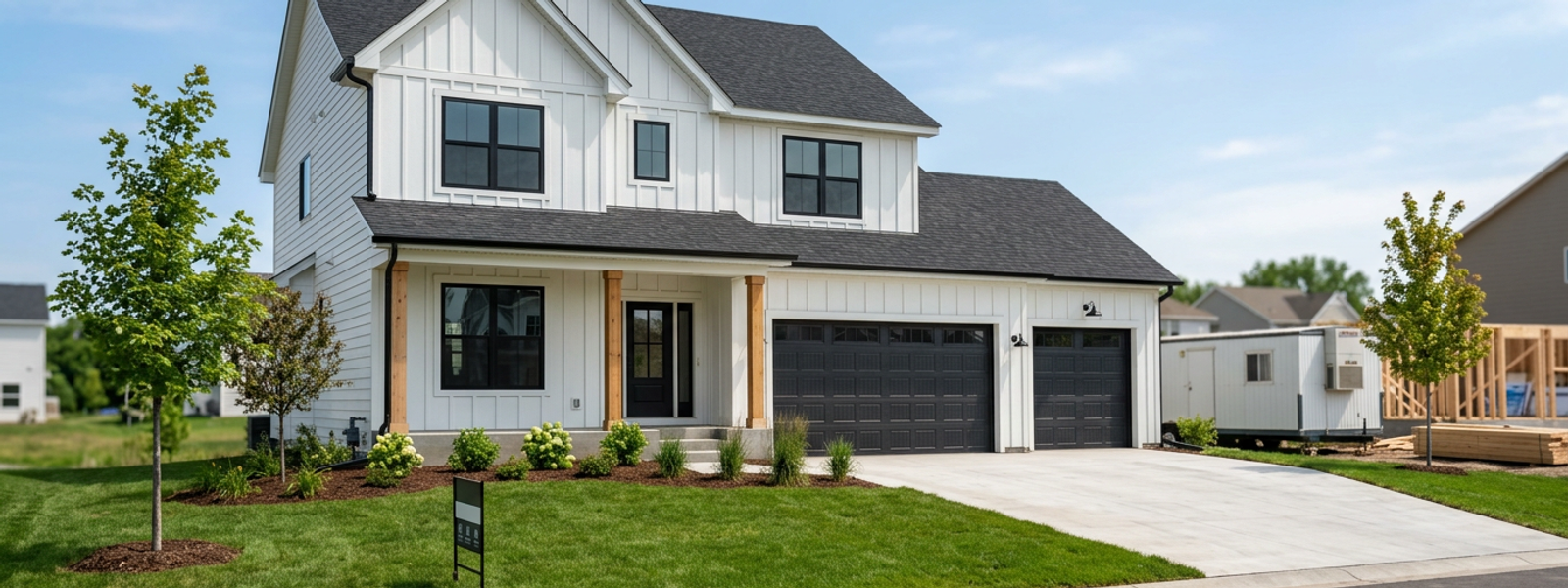
New construction homes have made up a growing share of the Minnesota market in 2026, especially in fast-growing suburbs of the Twin Cities and in rural and exurban areas where buildable lots are still available. For buyers tired of the inventory shortages and bidding wars of the resale market, new construction can be a welcome alternative: a home no one else has lived in, with the floor plan and finishes you actually want, and often a builder willing to negotiate on rate buydowns or upgrades in exchange for closing the deal.
But buying new construction is fundamentally different from buying a resale home. The purchase agreement is the builder's standard form (not the state-standard buyer-friendly contract). The financing process is longer and has more moving parts. The inspection rights are different. The warranty rights are different. And the negotiation levers — what you can push on and what you can't — are nothing like a resale transaction. This guide walks through what Minnesota buyers should know before signing a new construction contract in 2026.
Spec, semi-custom, and full custom: three different transactions
The new construction market is really three different markets, each with its own rules.
Spec homes (also called 'inventory' or 'quick move-in' homes)
A spec home is a house the builder has already started building (or finished) without a contracted buyer. The builder picked the floor plan, the lot, and most or all of the finishes. You're essentially buying a finished or near-finished product, and you can usually close on it in 30 to 60 days — much like a resale home. Spec homes typically offer the smallest customization but the most negotiating leverage on price, rate buydowns, and closing-cost concessions, especially if the home has been sitting on the market or carrying interest costs on the builder's construction loan.
Semi-custom homes (most common production builder model)
A semi-custom home is built to one of the builder's standard floor plans on a lot you select, with finishes you choose from a defined menu of options at the builder's design center. This is how the vast majority of new construction works in Minnesota — including most homes from production builders like Lennar, D.R. Horton, Pulte/Centex, and many regional builders. The process typically takes 5 to 10 months from contract signing to closing, you pick from a curated set of choices (cabinets, flooring, countertops, paint, lighting, plumbing fixtures), and your earnest money plus any selection deposits are at risk during construction.
Full custom homes (one-of-one builds)
A full custom home is built to your architectural plans on land you (usually) already own. The builder is acting more like a contractor executing your vision than a developer selling you a product. Timelines stretch to 9 to 18 months, financing flips entirely to a construction-to-permanent loan in your name (rather than buying a finished home from a builder), and decisions about everything from foundation type to window manufacturer fall on you. This is the path for buyers who want exactly what they want and are willing to manage the complexity.
The builder's contract: what's different from a normal resale offer
Builder purchase agreements are written by the builder's lawyers to protect the builder. They look nothing like the standard Minnesota Association of Realtors purchase agreement that buyers and listing agents typically use for resale homes. A few specific differences to watch for.
Earnest money deposits are larger and often non-refundable after a contingency window
Resale earnest money is typically 1-3% of the purchase price and refundable within negotiated contingencies. Builder earnest money is often 5-10% and may become non-refundable after a short inspection or financing review period (sometimes only 7-14 days from contract signing). On a $450,000 new build, that can be $25,000 to $45,000 at risk. Read the deposit-protection language carefully and ask your lender to give a fast loan approval if you're going to be exposed after the contingency closes.
Builder financing incentives often come with strings
Many builders advertise generous rate buydowns or closing cost credits, but they're typically contingent on using the builder's preferred lender (a captive lender, sometimes wholly owned by the builder). You're not required to use that lender — federal law protects your right to shop — but if you go elsewhere, the incentive may be reduced or removed. The right move is almost always to get a competing quote from an independent broker like DMF and compare the all-in cost (rate, points, fees, lender credits, and any builder incentive given up) head-to-head.
Inspection rights are limited
On a resale home, the buyer typically has a broad inspection contingency that allows them to cancel for any inspection-discovered issue. Builder contracts usually allow only a narrow 'pre-drywall walkthrough' and a final walkthrough before closing — not a full third-party inspection with cancellation rights. You can (and absolutely should) still hire your own independent inspector for both the pre-drywall and final walkthroughs, but your right to cancel based on what they find is much more limited than in a resale deal.
Closing dates are estimates, not promises
Builder contracts almost always reserve the builder's right to delay closing — sometimes by weeks or months — for weather, supply chain issues, labor shortages, or municipal inspection delays. Your contract typically protects your right to walk away with your earnest money returned if delays exceed a defined window (often 6 months past the original estimate), but smaller delays of 4-8 weeks are common and you'll be expected to absorb them. Plan your rate lock and your move-out from your current home accordingly.
Financing new construction: what's different from a resale purchase
How you finance a new build depends on which of the three new-construction paths you're on.
Spec home or semi-custom: a standard end-loan mortgage
For spec homes and semi-custom builds where the builder owns the land and is selling you a finished or to-be-finished home, your mortgage is functionally the same as a resale mortgage. You apply for a conventional, FHA, VA, or USDA loan; the lender does an appraisal once the home is far enough along; and you close when the certificate of occupancy is issued. The key wrinkle: rate locks are tricky because the closing date is uncertain. Most lenders offer extended-lock products (60-day, 90-day, 180-day, sometimes 270-day or more) at progressively higher cost, plus 'float-down' options if rates drop during the lock. We discussed extended locks and float-downs in our May 20 post on rate locks — for new construction, the math heavily favors paying for a longer lock rather than gambling on where rates will be in 6-9 months.
Full custom: construction-to-permanent loans
If you're building on your own land with an independent builder, you'll need a construction-to-permanent loan (also called a 'one-time close' or 'CTP' loan). This is a single mortgage that funds the build phase (interest-only payments on drawn amounts during construction) and automatically converts to a permanent 30-year mortgage when the certificate of occupancy is issued. DMF specializes in CTP loans and works with several wholesale lenders who offer them — typical requirements are 10-20% down, a 680+ credit score, an approved licensed builder, complete building plans with cost estimates, and a contingency reserve (usually 5-10% above the contract price).
Renovation loans for new-to-you construction
A less-discussed option is using a renovation loan — Fannie Mae HomeStyle or FHA 203(k) — to buy a newly-built home that needs final completion work (landscaping, fence, deck, finished basement). The renovation loan wraps the additional improvements into a single mortgage. This is most useful when a builder offers a base home at a competitive price but you want to add features they don't include.
Builder rate buydowns and incentives: how to evaluate them
In 2026, many production builders are aggressively offering rate buydowns, closing cost credits, and 'free' upgrades to move inventory. These offers are real value, but they need to be evaluated carefully because they're often paired with terms that limit your flexibility.
- Permanent rate buydowns (e.g., 'lock your rate at 5.49% for 30 years!') are usually funded by the builder paying discount points to the captive lender on your behalf. The savings are real, but the offered home price is often inflated to absorb the cost of the buydown. Always ask what the home would cost without the rate incentive.
- Temporary 2-1 buydowns lower your rate for years one and two before stepping up to the permanent note rate. These can be great if your goal is breathing room early on, but the payment jump in year three needs to fit your budget too.
- Closing cost credits ($10,000 to $20,000 is common in 2026) are direct cash you can apply to closing costs, prepaids, and rate buydowns. These are usually the most flexible and valuable form of builder incentive.
- 'Free' upgrades from the design center sound great but are usually retail-marked-up to begin with. The dollar value the builder claims is often 1.5-2x what the upgrades actually cost the builder. Negotiate cash credits where you can.
Here's the single most important practical step: get a written all-in cost comparison from the builder's preferred lender AND from an independent broker like DMF. Same loan amount, same closing date, same product, with every fee, every credit, and every concession included. Then look at the final cash to close and the final monthly payment — those are the only numbers that matter.
Inspections: what to do despite limited contractual rights
Even though builder contracts limit your right to cancel based on inspection findings, you should absolutely hire a private inspector for new construction. Aim for three inspection points.
- Foundation/pre-pour inspection: confirms grade, footings, drainage, waterproofing membrane, and rebar are correct before concrete is poured. This is the only chance to catch foundation defects that would otherwise be buried.
- Pre-drywall inspection: framing, electrical rough-in, plumbing rough-in, HVAC ductwork, insulation, and any structural elements are still visible. This is your best opportunity to catch issues that would become very expensive to fix after walls go up.
- Final/punch-list walkthrough: everything is finished, mechanicals are running, and the home is move-in ready. Test every outlet, faucet, light switch, window, door, and appliance. Note every defect (no matter how small) on the punch list — builders must address punch-list items before closing or via a post-closing warranty escrow.
Expect to pay $500-$900 for each inspection from a qualified third-party inspector. In Minnesota, look for inspectors certified by ASHI (American Society of Home Inspectors) or InterNACHI. Inspectors familiar with new construction know exactly where production builders cut corners and what to look for.
Warranties: what's actually covered after closing
New construction homes in Minnesota typically come with three layers of warranty coverage, often documented in a 'Builder's Limited Warranty' booklet provided at closing.
- Workmanship coverage (typically 1 year): the builder fixes defects in materials and workmanship. Things like trim gaps, cabinet drawers that don't close, paint defects, door alignment, etc.
- Systems coverage (typically 2 years): plumbing, electrical, HVAC, and mechanical systems are covered against defects.
- Structural coverage (typically 10 years): major load-bearing elements (foundation, framing, roof structure) are covered against material defects.
Minnesota also has a statutory home warranty under Minn. Stat. §327A that provides minimum warranty coverage on new homes built by licensed builders — 1 year on workmanship, 2 years on plumbing/electrical/HVAC, and 10 years on major structural elements. These statutory warranties are a floor, not a ceiling, and the builder's own warranty document may offer more (rarely less). Read both carefully and keep them with your closing documents.
Property taxes and homestead in Minnesota new construction
One detail that catches many Minnesota new-construction buyers off guard: property taxes on your first full year of ownership are based on the unimproved land value, not the value of the finished home. The taxes are low your first year and then jump dramatically in year two as the assessor catches up to the home's actual value. Plan for a meaningful escrow payment increase when your second-year escrow analysis runs.
Also file for Minnesota homestead classification within 30 days of closing if you'll occupy the home as your primary residence. Homestead status lowers your property tax bill (the homestead market value exclusion can reduce taxable value by up to $30,400 on homes valued under $413,800 as of 2024) and qualifies you for the Minnesota property tax refund. Filing is done through your county assessor's office — most counties have an online form.
How DMF helps with new construction purchases
Davis Monroe Financial is based in Mora, Minnesota and works with new construction buyers across the state, from Twin Cities suburbs to Central Minnesota lakeshore developments to fully custom rural builds. We provide three things that matter on a new build.
- Independent rate and incentive comparisons against the builder's preferred lender — apples-to-apples, all-in cost. We've seen builder incentives that look generous on paper but cost more than going independent once you compare every line.
- Construction-to-permanent loan expertise from wholesale lenders who actually like CTP loans (not all do). For custom builds, the right CTP product makes the difference between a smooth build and a stressful one.
- Extended rate locks with float-down protection that match your build timeline. We coordinate the lock date with the builder's projected closing so you're not gambling on rates 6-9 months out.
Bottom line
New construction buying in 2026 is a real opportunity for Minnesota buyers — more inventory, more customization, and meaningful builder incentives — but it requires more diligence than a typical resale purchase. The contract favors the builder, the financing is more complex, and inspection rights are limited. Buyers who go in with a clear understanding of how the process works, who hire their own inspectors, and who compare the builder's preferred lender against an independent broker tend to walk away with better deals and fewer surprises.
Davis Monroe Financial is a licensed Minnesota mortgage broker located at 2244 Hwy 65, Mora, MN 55051. Whether you're considering a spec home in a suburban development, a semi-custom build with a production builder, or a full custom home on your own land, we can walk you through the financing and incentive math before you sign anything. Call us at (320) 200-2821 or visit www.mydmf.com to get started.