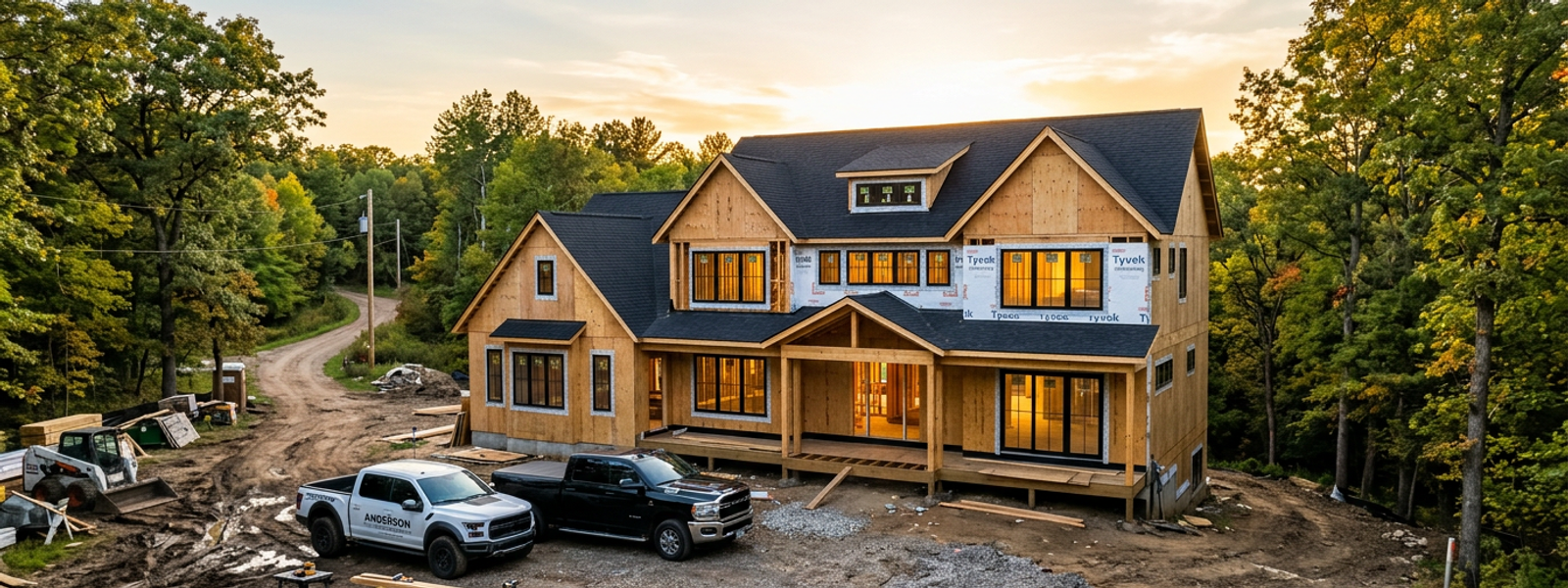
Building instead of buying used to mean juggling two separate loans: a short-term construction loan that funded the build, and a permanent mortgage that took over once the home was finished. In 2026, that traditional two-close structure is still available, but most Minnesota buyers building a home — whether a custom stick-built, a pole-frame, a barndominium, or a modular home on a rural lot — are opting for a construction-to-permanent (C2P) loan instead.
A construction-to-permanent loan is a single loan with a single closing that funds the build, then automatically converts into a standard 15-, 20-, or 30-year mortgage once the home is finished. One application, one appraisal, one set of closing costs, and — if you set it up right — one interest rate lock covering the whole timeline.
This guide walks through how C2P loans actually work in Minnesota in 2026, what lenders are checking, how the draw schedule flows, what disqualifies most files early, and how the conventional, FHA, VA, and USDA versions compare.
How a construction-to-permanent loan works
Think of a C2P loan as two loans bolted together with a single closing:
- Construction phase: interest-only payments on the amount drawn, typically over 6 to 12 months while the home is built. You are not paying principal yet, and you only pay interest on the money that has actually been disbursed to the builder.
- Permanent phase: at completion, the loan automatically modifies into a standard amortizing mortgage — usually 30-year fixed, though 15- and 20-year options are available. Regular principal-and-interest payments begin.
Because the closing happens once — at the start — you lock the interest rate for the permanent phase before you break ground. That is a huge advantage if rates move against you during construction, but it also means the lender needs to underwrite the whole project up front, including you, your builder, and the home itself.
One-close vs. two-close
There are two versions of construction financing still in the market. Choosing the right one matters.
One-close (true construction-to-permanent)
Single closing, single set of closing costs, single interest rate covering both construction and the permanent loan. You are underwritten once. The lender may re-verify income, credit, and employment before conversion, but you do not re-apply. This is the structure most Minnesota buyers want in 2026.
Two-close (construction loan + separate takeout mortgage)
A short-term construction loan funds the build. When the home is finished, you refinance into a separate permanent mortgage — a new application, a new appraisal, and a new set of closing costs. The downside is obvious: you pay closing costs twice, you re-qualify with whatever your finances look like at completion, and you take rate risk during the entire build. The upside is flexibility — some borrowers who cannot qualify for permanent financing yet (a self-employed borrower building income history, for example) use the construction phase to buy time before they need a takeout.
For most Minnesota buyers, one-close is the default answer. Two-close makes sense in narrow situations only.
Down payment and credit requirements in 2026
Because the lender is funding a home that does not yet exist, C2P loans are underwritten more conservatively than a standard purchase mortgage:
- Credit score: most conventional C2P programs want a minimum FICO of 680 to 700. The best pricing lives at 740+.
- Down payment: conventional C2P loans typically require 10% to 20% down. Some lenders will go as low as 5% for very strong files, but 20% is the norm.
- Debt-to-income (DTI): expect a 43% cap on most programs, with the fully amortized permanent payment used in the ratio — not the interest-only construction payment.
- Reserves: many lenders require 3 to 6 months of PITI in reserves after closing to cover unforeseen construction cost overruns.
- Contingency reserve: a project-level contingency of 5% to 10% of hard costs is usually required and financed into the loan, in case something during the build costs more than budgeted.
Government-backed C2P options
The government loan programs all support one-time close construction financing, and each one has real advantages for the right buyer.
FHA one-time close construction loan
FHA allows a single-close construction-to-permanent loan with as little as 3.5% down for buyers with a 580+ credit score. All the standard FHA rules apply — including up-front and monthly mortgage insurance premiums — and the home must be built to HUD's Minimum Property Standards. FHA C2P is especially useful in Minnesota for first-time buyers building on inherited or family-owned land.
VA one-time close construction loan
Eligible veterans and active-duty service members can build a home with 0% down using a VA construction-to-permanent loan. VA C2P loans are fully underwritten to the veteran's entitlement, and the funding fee still applies. The lender pool for VA construction financing is thinner than for VA purchases, so it is worth asking your broker who they use for VA C2P specifically.
USDA single-close construction loan
USDA offers a single-close construction-to-permanent loan with 0% down for eligible rural properties — which covers a large share of central and northern Minnesota outside the Twin Cities metro. Income limits apply, and the home must be in a USDA-designated rural area. This is one of the most powerful, under-used options for building in greater Minnesota.
Conventional (Fannie Mae/Freddie Mac) C2P
Conventional single-close loans typically require 10% to 20% down, but they offer the widest lender pool, the most flexibility on property types (including modular, log, and some barndominium builds), and no upfront funding fee or MIP. Buyers with 20% down can also avoid ongoing mortgage insurance from day one of the permanent phase.
How the draw schedule actually works
During construction, the lender does not hand the full loan amount to your builder on day one. Instead, funds are released in stages tied to completed work — this is the draw schedule. A common Minnesota draw schedule for a single-family home looks like this:
- Draw 1: foundation complete.
- Draw 2: framing, roof, and windows complete ("dried in").
- Draw 3: mechanicals (plumbing, HVAC, electrical rough-in) complete.
- Draw 4: drywall, interior finishes, cabinets.
- Draw 5 (final): certificate of occupancy issued and final inspection passed.
Each draw is triggered by an inspection by the lender's inspector or a third-party firm, who confirms the work is actually done before releasing the funds. Your builder invoices for each stage, the lender verifies, and the funds move to the builder. Some lenders reimburse the builder after the work is done; others advance funds against approved invoices.
What lenders check before they approve
Underwriting a C2P loan is really three underwrites in one: you as a borrower, the builder as a partner, and the project as a viable asset. Skip any of these three and the file stalls.
The borrower
Standard mortgage underwriting: two years of income history, two months of bank statements, credit report, and asset verification. Because the loan is often larger than an average purchase and the risk timeline is longer, expect closer scrutiny of DTI and reserves.
The builder
This is where a lot of Minnesota C2P files quietly die. Lenders will require:
- A licensed, insured general contractor with a proven track record on similar projects. For most residential C2P loans in Minnesota, that means a licensed Minnesota builder in good standing.
- References and photos of at least a few completed comparable projects.
- Financial statements or a builder resume showing the company is stable and has been in business long enough to be trusted with a multi-month build.
- Certificate of insurance and workers' comp coverage naming the lender.
- For some larger loans, a builder acceptance letter or approval from the lender's construction team.
If the builder cannot get approved, the file cannot move forward — even if you personally qualify. This is why it is critical to pick your builder early, and to make sure they have experience with lender draw processes.
The project
The lender also underwrites the home itself, on paper, before it exists. You will need:
- A signed fixed-price or guaranteed-maximum-price construction contract with your builder.
- Detailed plans and specifications (blueprints, materials lists, allowances).
- An itemized construction budget.
- Approved building permits (or a clear path to them) and confirmation of proper zoning.
- A recorded lot survey and, in rural Minnesota, verification of septic and well systems and access to utilities.
- An "as-completed" appraisal — a projected valuation of what the home will be worth when finished, based on the plans, specs, and comparable sales.
The Minnesota lot: financing options
If you already own the lot, most C2P programs treat the equity as part of your down payment. If you still need to buy the land, you have two main paths:
- Bundle the lot purchase into the C2P loan. Many one-close programs let you finance the land purchase, closing costs, and construction all in one loan. This is the simplest structure when you have not yet purchased the parcel.
- Use a separate lot loan first, then roll it into the C2P. Some buyers use a lot loan to acquire land, sit on it for a season while designing, then refinance into a C2P when they are ready to build. This adds a closing but can save time later.
In central and northern Minnesota, small acreage parcels can be affordable, but access to power, water, and internet plus proper soil and setback conditions matter more than raw acreage. Talk to your builder and lender before you close on any land — some parcels look great but cannot be economically built on.
Costs to expect
Beyond the down payment and standard closing costs, C2P borrowers should plan for:
- Contingency reserve: 5% to 10% of hard construction costs financed into the loan.
- Inspection fees for each draw (usually $150 to $300 per draw).
- As-completed appraisal (often $700 to $1,200 in Minnesota for a full construction appraisal).
- Extended rate lock fees if the lock window is longer than 6 months.
- Interest reserve or interest-only payments during the construction phase. Some borrowers escrow the construction-phase interest into the loan to avoid making monthly payments during the build.
- Builder's risk insurance during construction, plus standard homeowners insurance in place before conversion.
Common Minnesota approval killers
After working with local buyers who have built homes across central Minnesota, a few patterns show up repeatedly:
- Choosing a builder who is not lender-approved. Even a great local builder can be a poor fit for lender underwriting if they have never worked with construction draws. Ask your lender for a list of approved builders before you sign a contract.
- Missing contingency reserve. Files that budget 100% of hard costs with no contingency get pushed back for restructuring. Add 5% to 10% up front.
- Underestimating soft costs. Septic, well, driveway, site prep, and utility hookups are frequently forgotten. In rural Minnesota, site work can add $30,000 to $75,000 to a build.
- Cost overruns without documentation. If the budget increases mid-build, expect the lender to require change orders and, sometimes, an updated appraisal before releasing the next draw.
- Building without a fixed-price or GMP contract. Cost-plus contracts are much harder to underwrite because the total loan amount is not fixed.
- Weather delays and the Minnesota build season. Foundations poured too late in the fall can push framing into winter and create scheduling problems. A realistic build timeline built around Minnesota weather goes a long way with lenders.
Converting to permanent: the finish line
When the home is finished, three things need to happen for the loan to convert:
- Final inspection and certificate of occupancy from the local building department.
- Final draw and lien releases from the builder and all subcontractors, confirming everyone has been paid.
- Loan modification paperwork with the lender — usually a quick sign-off that converts the loan to its permanent terms.
For most one-close loans, no new appraisal is required at conversion (the as-completed appraisal already covers it). Your first regular mortgage payment is typically due 30 to 60 days after the modification.
Practical timeline for a Minnesota C2P
A realistic 2026 timeline for a single-family C2P loan in Minnesota, from pre-approval to move-in:
- Weeks 1–4: pre-approval, lot selection (if needed), builder selection, initial designs.
- Weeks 4–10: finalize plans and specs, sign construction contract, submit full lender package, order as-completed appraisal, obtain permits.
- Weeks 10–14: underwriting, conditions, final approval, closing.
- Months 4–10: construction, draws every 4 to 8 weeks.
- Month 10–12: final inspection, certificate of occupancy, conversion to permanent loan, move-in.
Most Minnesota custom homes take 8 to 12 months from ground-breaking to move-in. Modular and pole-frame builds can compress that timeline significantly.
How to set yourself up for approval
If you are seriously thinking about building in Minnesota in 2026, three moves make a big difference before you ever formally apply:
- Get pre-approved for the permanent loan first. Know your maximum borrowing power before you design a house.
- Interview builders early, and confirm they are willing and able to work with a lender's draw process.
- Get a real budget on paper — not just hard construction costs, but site work, permits, driveway, well, septic, landscaping, and a contingency line. Undersized budgets are the single most common reason C2P files get restructured or denied.
Talk to a Minnesota broker before you break ground
Construction-to-permanent loans are one of the most specialized products in residential lending. The lender pool is narrower than for standard purchases, the underwriting is deeper, and small details in the construction contract or the builder's paperwork can slow the whole file down. Working with a Minnesota broker who has already closed C2P loans locally saves you time, money, and a lot of avoidable stress.
Davis Monroe Financial is a licensed Minnesota mortgage broker based in Mora. We work with conventional, FHA, VA, and USDA construction-to-permanent programs and can match you to the right lender based on your builder, your lot, and your loan size. If you are considering building in central Minnesota — or anywhere in the state — we would rather have the conversation before you sign a construction contract than after.
Call Davis Monroe Financial at (320) 200-2821 or visit www.mydmf.com to talk through your project. We will help you pick the right loan structure, run the real numbers, and set you up for a smooth build from foundation to certificate of occupancy.
Davis Monroe Financial | 2244 Hwy 65, Mora, MN 55051 | (320) 200-2821 | www.mydmf.com