If you're shopping for a home in Central Minnesota in 2026 and you're not buying in the Twin Cities metro, there's a strong chance the property you're looking at qualifies for one of the most underutilized mortgage programs in the country: the USDA Rural Development guaranteed loan. It's the only major loan program besides VA that offers true zero-down financing, and unlike VA, you don't have to be a veteran to use it.
The catch — and the reason USDA loans are often overlooked — is that they're tied to property location and household income. If your home address is on the wrong side of an invisible USDA eligibility line, or your household income is just above the cap, you can't use the program. But for buyers who do qualify, the savings versus a 3.5% FHA loan or a 3% conventional loan can be substantial. This guide walks through how the program works in 2026, who qualifies, what it actually costs, and how Minnesota buyers can stack USDA financing with other assistance for a near-zero-cash closing.
What is a USDA loan, exactly?
USDA Rural Development offers three main home loan programs: the Section 502 Guaranteed Loan (the most common, originated by approved lenders like the ones DMF works with), the Section 502 Direct Loan (originated directly by USDA for very low income borrowers), and the Section 504 Home Repair Loan and Grant program. The Guaranteed program is what most Minnesota buyers will use, and it's what this guide focuses on.
A USDA Guaranteed loan is a 30-year fixed-rate mortgage made by an approved lender and backed by a guarantee from USDA Rural Development. Because the federal government guarantees the loan against default, lenders can offer favorable terms: no down payment requirement, competitive interest rates (often comparable to or slightly below conventional rates for the same credit profile), no maximum purchase price (only an income test), and lower monthly mortgage insurance than FHA.
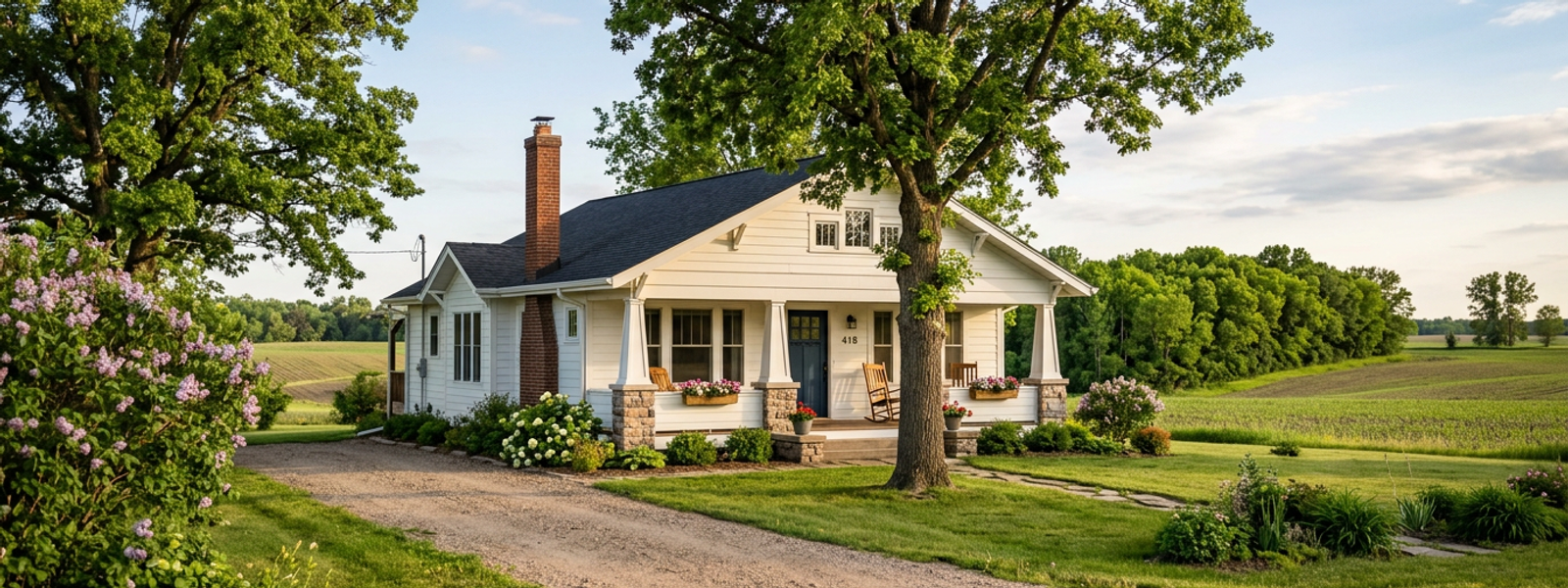
USDA loans are intended to encourage homeownership in rural and small-town America. But the definition of 'rural' is broader than most buyers think — much of Central Minnesota, including the entire city of Mora and most of Kanabec County, qualifies. So do Milaca, Cambridge, Princeton, Pine City, Hinckley, Onamia, Mille Lacs Lake-area communities, much of Morrison and Todd counties, and dozens of other Minnesota towns.
The two eligibility tests: property and income
USDA eligibility is unusual because it has nothing to do with whether you're a first-time buyer. It has everything to do with where the house is and how much money your household earns. Both tests have to pass.
Property eligibility: is the address USDA-approved?
USDA maintains a property eligibility map at eligibility.sc.egov.usda.gov where you can type any address and see whether it's in a USDA-designated rural area. The boundaries follow census data and are updated periodically (the last major refresh was in 2024). In Minnesota, the Twin Cities metro counties (Hennepin, Ramsey, Anoka, Dakota, Washington, Carver, Scott) are mostly ineligible, while most of the rest of the state — including the entire Central Minnesota corridor where DMF is based — is fully eligible.
A few practical notes on property eligibility. First, even in eligible counties, certain larger towns may have small ineligible pockets — usually the densely populated downtown core. Second, the eligibility status of an address is what matters, not the city or zip code. Always check the specific property address before writing an offer. Third, USDA does not allow second homes, vacation homes, or investment properties. The home must be your primary residence.
Income eligibility: are you at or under the household income cap?
USDA caps your household income at 115% of the area median income (AMI) for the county where the property is located. The cap is based on total household income, not just the income of the people on the mortgage. That means if a non-borrowing adult lives in the home, their income often counts toward the cap (with some exceptions for students, dependents, and elderly relatives).
Income limits change annually and vary by county and household size. In Central Minnesota counties like Kanabec, Mille Lacs, Isanti, and Pine in 2026, the income limit for a household of 1-4 is in the range of about $110,000 to $115,000, and the limit for a household of 5-8 is roughly $145,000 to $152,000. The limit is higher in metro-adjacent counties and lower in deeply rural ones. You can look up the current limit for any county at the USDA Income Eligibility tool — your loan officer will run the official calculation as part of pre-approval.
One nuance worth understanding: USDA's income calculation includes some sources that don't show up on a typical mortgage application — alimony, child support, social security, and recurring bonuses — and excludes certain deductions (like dependent care costs). The number USDA uses to determine eligibility may not be the same number your conventional underwriter would use, so the only reliable way to know if you qualify is to have a USDA-approved lender run the math.
The two USDA fees you need to know about
USDA doesn't call it 'mortgage insurance,' but the program does charge two fees that function similarly. Both go to USDA, not to the lender, and together they're meaningfully cheaper than FHA's UFMIP plus annual MIP.
Upfront guarantee fee
USDA charges a one-time upfront guarantee fee of 1.00% of the loan amount, which is typically financed into the loan rather than paid in cash at closing. On a $300,000 home with zero down, the upfront fee adds $3,000 to the loan amount, making the starting balance $303,000. This is significantly lower than FHA's 1.75% upfront premium, which would add $5,250 on the same loan.
Annual fee
USDA also charges an annual fee of 0.35% of the loan balance, paid in monthly installments as part of your mortgage payment. On a $300,000 loan, that's about $87.50 per month in year one, dropping slightly each year as the balance amortizes down. Compare that to FHA's typical 0.55% annual MIP on the same loan (around $137.50 per month), or to conventional PMI which varies but often runs $150 to $250 per month for low-down-payment borrowers — and the savings add up quickly.
Unlike FHA mortgage insurance (which can stay on the loan for the full term in many cases), the USDA annual fee remains for the life of the loan but is a smaller bite each month. Most USDA borrowers eventually refinance into a conventional loan once they've built enough equity to drop mortgage insurance entirely, but the timing depends on rates and equity growth.
Credit, debt-to-income, and what underwriters actually look for
USDA doesn't publish a minimum credit score for the Guaranteed program — instead, it relies on lenders to apply their own credit standards. In practice, most USDA-approved lenders require a credit score of 640 or higher to approve a loan with automated underwriting. Borrowers with scores below 640 can sometimes still qualify through manual underwriting, but the documentation and compensating-factor requirements are stricter.
Debt-to-income (DTI) ratios are also evaluated more carefully than for some other loan programs. USDA's standard guidance is a maximum 29% housing ratio (your principal, interest, taxes, insurance, and HOA divided by gross monthly income) and a maximum 41% total DTI. The total DTI cap can sometimes be stretched up to 44% or higher with strong compensating factors — long employment history, significant cash reserves, a high credit score — but exceptions require a stronger overall file.
Two things underwriters specifically watch for on USDA files. First, all delinquent federal debt (including student loans, taxes, and child support) must be resolved before closing. Second, the property must meet USDA's modest housing standard — no luxury features like in-ground pools (in some cases), and the home must be in good condition with no major repair issues.
How USDA, FHA, and conventional 3%-down compare on the same Minnesota home
Let's run the math on a $300,000 home purchase in Central Minnesota for a borrower with a 700 credit score. We'll assume each loan is a 30-year fixed at the same starting interest rate of 6.50% (in reality USDA and conventional are typically very close, with FHA sometimes slightly lower).
- USDA: $0 down. Upfront fee 1.00% financed into the loan ($3,000), so starting balance is $303,000. Monthly principal and interest is about $1,915. Annual fee 0.35% adds about $88/month. Total monthly P&I + USDA fee: about $2,003. Cash to close (closing costs only, after seller concessions): often $0 to $4,000.
- FHA: 3.5% down ($10,500). Upfront premium 1.75% financed ($5,066), so starting balance is $294,566. Monthly P&I about $1,862. Annual MIP 0.55% adds about $135/month. Total monthly P&I + MIP: about $1,997. Cash to close: $10,500 plus closing costs.
- Conventional 3% down: 3% down ($9,000). No upfront fee. Starting balance $291,000. Monthly P&I about $1,839. Conventional PMI at 700 score and 97% LTV runs roughly $175/month. Total monthly P&I + PMI: about $2,014. Cash to close: $9,000 plus closing costs. Plus a clear path to drop PMI at 78% LTV.
Three takeaways. First, total monthly cost across these three options is remarkably similar — within about $20 of each other. Second, USDA wins decisively on cash needed at closing, which is the deal-maker for buyers without large savings. Third, conventional is the only program with a clear path to drop mortgage insurance via amortization or appraisal — USDA's annual fee stays for life unless you refinance.
Stacking USDA with Minnesota Housing assistance
USDA loans pair well with Minnesota Housing Finance Agency (MHFA) down payment and closing cost assistance. The MHFA Start Up program for first-time buyers, and the Step Up program for repeat buyers, can both be layered on top of a USDA first mortgage. While USDA doesn't require any down payment, MHFA assistance can cover most or all of the closing costs — up to $18,000 in some cases — meaning a qualified buyer can close on a home with as little as $0 to $1,000 out of pocket.
Seller concessions are also generous on USDA loans. Sellers can contribute up to 6% of the sale price toward buyer closing costs, prepaids, and rate buydowns. Combined with MHFA help, this creates a path to true zero-cash closing for many Minnesota first-time buyers.
One important caveat: USDA does not allow you to use seller concessions or assistance funds to pay back the buyer at closing. Funds can only be used to cover legitimate buyer expenses (closing costs, prepaids, escrow setup, rate buydowns). If MHFA assistance plus seller concessions exceeds what's actually needed at closing, the excess gets applied to the loan principal — not refunded to the buyer.
What the USDA process looks like, step by step
Closing a USDA loan in Minnesota typically follows the same general path as any other mortgage, with a few extra steps and a slightly longer timeline.
- Pre-approval: lender pulls credit, verifies income, runs the USDA income eligibility calculation, and issues a pre-approval letter.
- Property identification: buyer and agent check the property's USDA eligibility status on the official map before writing an offer.
- Purchase offer: signed agreement, inspection contingency recommended, seller concessions written in if applicable.
- Processing and underwriting: lender orders appraisal, verifies all income documents, runs the file through Guaranteed Underwriting System (GUS).
- Conditional commitment from USDA: after lender approval, the file is submitted to USDA Rural Development for the final conditional commitment. This step adds 3-10 business days versus a conventional loan.
- Closing: documents signed, funds disbursed, keys handed over. Total timeline is typically 35-50 days from accepted offer to closing.
The USDA conditional commitment step is the main reason USDA loans close slightly slower than conventional or FHA loans. Plan your closing date with 5-10 extra days of cushion, especially during periods when USDA's processing queue is backed up (typically late fall and early winter, when the federal fiscal year cycle creates bottlenecks).
When USDA isn't the right choice
USDA is powerful for buyers it fits, but it's not always the best loan even when you qualify. Here are scenarios where another loan program usually serves the buyer better.
- Your household income is borderline at the 115% AMI cap and may rise over the next year (job change, partner returning to work): even if you qualify today, you risk being recaptured if circumstances change before closing.
- You want to drop mortgage insurance once you build equity: conventional gives you that path; USDA does not, short of a full refinance.
- You're buying in a neighborhood that's mostly ineligible with only a few qualifying parcels: your home selection will be unusually narrow, and you may give up better-fit homes to keep the USDA option.
- The home needs repairs that USDA won't allow until they're completed: USDA's property condition standards are stricter than conventional's, and a tight closing timeline may not allow for the required pre-closing repairs.
- You have strong cash reserves and a high credit score, and you want flexibility: a conventional 3% or 5% down loan with PMI you can drop later may serve you better long-term.
How DMF helps Minnesota buyers with USDA loans
Davis Monroe Financial is based in Mora, Minnesota — squarely in USDA-eligible territory — and we work with USDA Guaranteed loans every week. As a mortgage broker, DMF shops USDA-approved lenders to find competitive rates and the lender most likely to approve your specific situation. Because USDA underwriting is centralized through USDA's GUS system, the loan terms across approved lenders are similar; the differences come down to processing speed, lender overlays, and how a lender handles edge cases (non-traditional income, manual underwriting, repair contingencies, MHFA stacking).
If you're considering a home in Kanabec, Mille Lacs, Isanti, Pine, Morrison, Todd, or any of the surrounding rural Minnesota counties, the first practical step is a free USDA eligibility check — both the property address and your household income. We can run both checks in about 10 minutes and tell you whether USDA is a real option for you before you start writing offers.
Bottom line
USDA Rural Development Guaranteed loans are one of the most generous mortgage programs available — zero down, competitive rates, lower mortgage insurance than FHA, and seller concessions of up to 6%. The trade-off is strict property eligibility (rural and small-town locations only) and household income limits (115% of area median income). For Minnesota buyers shopping outside the Twin Cities metro, USDA is often the most affordable path to homeownership and deserves a serious look during pre-approval.
Davis Monroe Financial is a licensed Minnesota mortgage broker located at 2244 Hwy 65, Mora, MN 55051, serving buyers across the state. To check whether USDA financing fits your situation, or to compare USDA against FHA and conventional options for your specific scenario, call us at (320) 200-2821 or visit www.mydmf.com to start a free pre-approval.